Welcome: 7reading
Language:
 ∷
∷

∷
 ∷
∷


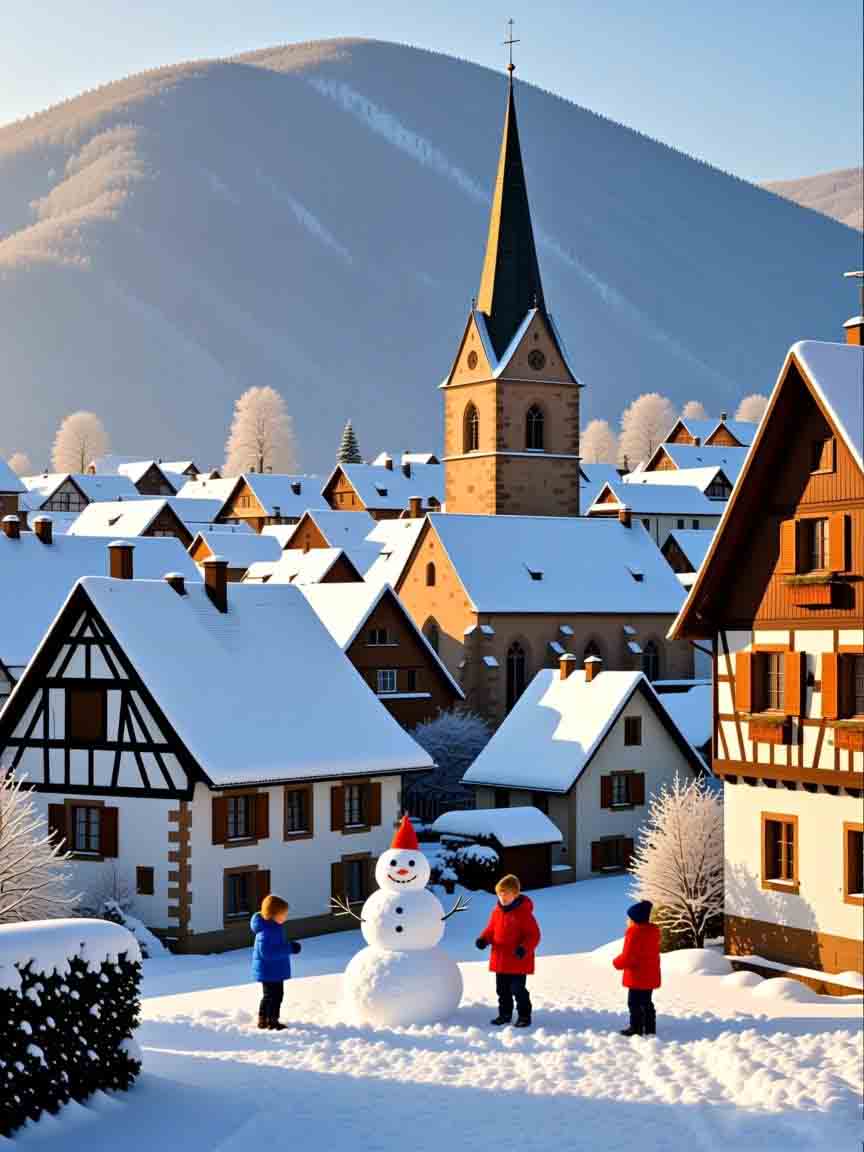
In an era of intense collision between globalization and local identity, how should we position ourselves? A Year in Alsace, a collection of essays co-authored by father Shen Fuyu and his daughter Shen Hangzhi, provides a mirror reflecting the modern spiritual predicament. In 2012, Shen Fuyu, as a correspondent for Nanjing Daily in France, along with his wife, a visiting scholar in France, took their 12-year-old daughter Shen Hangzhi to live for a year in Alsace in southern France. Through their unique dual perspectives, the book records their experiences and reflections in Alsace and across Europe. Through the eyes of these two generations, we gain profound insights into cultural adaptation, identity, and personal growth.
Stepping onto foreign soil and facing unfamiliar languages and customs can trigger an instinct to withdraw. At her international middle school in France, Shen Hangzhi encountered classmates from around the world: France, the United States, Japan, Spain, Germany, Italy, and even war-torn Syria. This miniature "United Nations" was not easy to integrate into.
Such cultural shock is increasingly common for modern individuals. True integration does not mean abandoning oneself, but rather approaching differences with openness, initiative, and a willingness to understand and appreciate them. This requires setting aside prejudices and engaging with new cultures with curiosity rather than judgment. In workplaces, communities, and even virtual social spaces, this cultural adaptability has become an essential quality for modern people.
In an unfamiliar environment, the question "Who am I?" becomes particularly sharp. When Shen Hangzhi faced communication barriers with her classmates in France due to language obstacles and cultural differences, she often thought of her school and classmates in Nanjing, with homesickness quietly creeping up on her
This identity anxiety is not unique to sojourners. In a modern society with diverse values, people often switch between different social roles, undergoing continuous identity negotiation. The year in Alsace teaches us that cultural identity is neither singular nor static, but constantly constructed through experience and reflection. Accepting this fluidity allows us to face ourselves more comfortably.
The "craziness" of the French school baffled Shen Hangzhi, a top Chinese student. French classes were so free that it was almost impossible to complete a lesson without interruptions from students' discussions and horseplay. The boys were rascals yet gentlemen: they might mischievously set fire to the sports shed, yet they addressed girls as "Mademoiselle," and bullying a girl would bring collective contempt.
This educational approach starkly contrasts with Chinese rigor. The inspiration for modern education is that no single educational model is perfect; the key lies in cultivating students' independent thinking and adaptability. In an age of information explosion, cross-cultural understanding and critical thinking are more important than the mechanical accumulation of knowledge.
In the boisterous French schoolyard, Shen Hangzhi admitted she was often "the expressionless girl in the chaotic campus scenes. She wasn't comfortable with the parties French children loved, preferring to maintain a certain distance.
This choice is highly instructive for modern people. In an era that encourages socializing and emphasizes fitting in, the choice to observe is also a legitimate right. Whether in social situations or workplace environments, maintaining personal boundaries is as important as active participation. A healthy society should allow people of different temperaments to exist in ways comfortable to them.
Unlike Shen Hangzhi's school life, the Europe under Shen Fuyu's pen was more. But he also noted that Europeans stubbornly retain a somewhat bourgeois, sentimental approach to life—perhaps the best way to hold onto time. The most beautiful parts of Europe were not the big cities, but the vast countryside, untouched by the world, quiet and secluded.
In a modern society that prioritizes efficiency, this philosophy of "slowness" has profound corrective significance. It reminds us: The quality of life lies not in speed, but in depth and breadth. Stepping back from busyness from time to time to enjoy leisure can enhance creativity and life satisfaction.
With a reporter's acuity, Shen Fuyu observed the troubles beneath Europe's glossy surface. His writings mention many unemployed and demonstrators, the ongoing impact of the European debt crisis, and a continent worrying about the future. This "heaviness" of reality contrasts sharply with the轻松 school life his daughter describes.
This dual reality reminds modern people that while focusing on personal development, we should also maintain a clear awareness of our social environment. True wisdom in life lies in seeing both beauty and deficiency simultaneously, and finding a balance between them.
The most unique aspect of A Year in Alsace is the interactive writing between father and daughter. The father's text is in conventional black type, while the daughter's is marked in green. Two perspectives, two voices, harmonious yet different.
This writing style is itself a model for intergenerational dialogue. In a society where generation gaps are increasingly evident, effective communication does not require one party to convince the other, but mutual respect, honest expression, and empathetic understanding. The family can become a space where diverse viewpoints coexist, not a place for homogenizing thought.
At her French school, Shen Hangzhi faced many European classmates' misconceptions about China: two Italian boys thought Hong Kong was a Japanese city; classmates thought Asia had only one language; they believed "Chinese people know kung fu and eat dog meat for every meal.
These prejudices, in turn, prompt us to reflect: Are our perceptions of other cultures not also a kind of benign prejudice? Modern people need to abandon either-or thinking and embrace the world's complexity and diversity, dispelling misunderstandings through communication.
Whether it was Shen Hangzhi's longing for her Nanjing classmates or her Syrian schoolmate, who had fled war, telling his mother, "I will return home as soon as the war stops, I will leave the second day it stops, homesickness is a universal human emotion.
In this era of frequent population mobility, homesickness is no longer the emotional monopoly of specific groups. Acknowledging and placating homesickness is an important task for the modern sojourner. Meanwhile, this shared emotion can also become a bridge connecting people from different backgrounds.
The year in Alsace was a year of growth for both Shen Fuyu and his daughter Shen Hangzhi. For the father, it was a professional experience of observing European society up close; for the daughter, it was a pivotal year of broadened horizons and rapid growth.
This experience enlightens us: Sometimes, we need to step out of our familiar environment and rediscover ourselves and the world through life 'elsewhere.' This isn't necessarily physical relocation—it can also be an intellectual departure: staying open and curious, allowing life to constantly encounter new possibilities.
Une Année en Alsace ultimately shows us that between globalization and locality, tradition and modernity, and openness, there is no simple either-or choice. True wisdom lies precisely in accepting both ends simultaneously and finding one's unique position within them.
Whether it is Shen Fuyu's reflections on European history and reality or Shen Hangzhi's balance between two educational systems, both point to the same theme: The sense of belonging for modern people no longer comes from a single root, but from the ability to build connections in a diverse world.
This book is a spiritual guide for modern people navigating globalized life. It does not offer simple answers but demonstrates how to maintain grace amidst complexity and continue moving forward amidst confusion.
Contact: seven
Phone: 139102782@qq.com
Tel: 139102782@qq.com
Email: 139102782@qq.com
Add: Guangzhou China




 7reading
 7reading
 7reading